
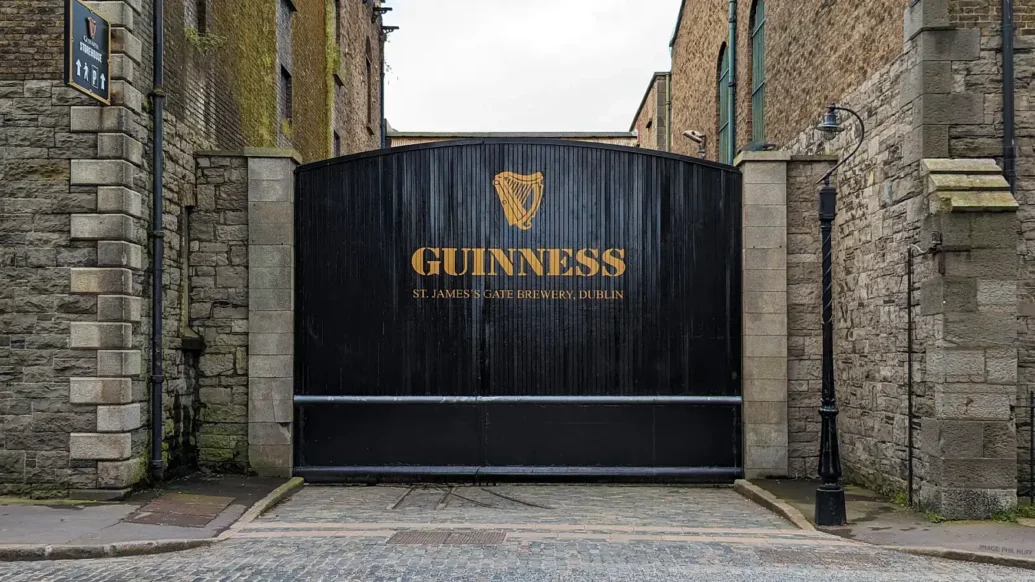
A visit to Dublin wouldn’t be complete without a trip to the Guinness Storehouse. The brewery’s founder, Arthur Guinness, had so much faith in the success of his venture that he signed a 9,000-year lease on the property at St James’s Gate in 1759. With more than 13 million pints of the famous brew served globally on St Patrick’s Day alone, he clearly got something right.
While a brewery has been on the 55-acre site for 265 years, the Guinness Storehouse started life as a fermentation plant, initially built in 1902. It remained a working part of the brewery until 1988, when it was finally redesigned before opening as a visitor centre in December 2000.
Walking towards the Guinness Storehouse — just a 20-minute walk from the centre of Dublin — you get a sense of the brewery’s scale and history. Grey stone walls line partially cobblestone streets, with railway tracks laid in the 1870s that moved 8,000 barrels a day still embedded in the roadway. The steam-powered trains stopped under the hoists which spanned the road and would have lifted the heavy grain from the carriages and through the large doors for processing. Just before you turn the corner to the entrance, the iconic black gate comes into view — the perfect location for a selfie!

Guinness Storehouse Experience
With ticket in hand, we headed into the building and towards the self-guided element of the Guinness Storehouse. Every 10 minutes or so, there’s a welcome speech from one of the brewery experts, giving a short introduction to the exhibition and drawing your attention to a copy of the lease signed by Arthur Guinness under a glass panel in the floor. It’s an interesting idea, but it means you can’t get a good view of it unless you get down on your hands and knees.


If you want a little more information during your self-guided tour, audio guides are available in multiple languages at an extra cost, but there is also plenty of information to read and view as you make your way through the exhibition floors. It was a fascinating walk through the making of Guinness, with plenty of history thrown in there, too. You don’t actually see any of the brewing process itself taking place, but there are videos and images galore. It’s all supported by materials and exhibits, from grains in various states of roasting and multiple styles of barrels to one of the trains that ran along the rails around the site and a demonstration of the 300 million bubbles you’ll find in every pint. No, we don’t know how they counted them, either.

Get engrossed, and you’ll need about 90 minutes to make your way around before heading to Gravity, the rooftop bar, for the pint of Guinness included in your ticket price.
Guinness Storehouse: The Connoisseur Experience
We had tickets for the Connoisseur Experience (which includes entry to the self-guided element) so we headed to an exclusive area at our allotted time.
It’s a small group experience, limited to just 16 people for each session, although ours was even more bijous with just 10 visitors gathering outside the private bar.
Once ushered in, we met our expert, Antonio, who spent the next 75 minutes or so bringing the history of Guinness alive, talking about the flavour history and evolution of the drink and the plethora of varieties sold around the world — and we had to taste many of them, of course!

We’re not Guinness connoisseurs, despite taking the Connoisseur Experience, so we were surprised to learn that Guinness, as we know it, has only been around since 1959.
We sampled many of Guinness’s brews, including Guinness Original, which predates the current expression. That was joined by Guinness Foreign Extra, the best-selling beer in Nigeria and a brew that accounts for 45% of the company’s global sales. Amongst others, we also sampled Hop House 13 lager and Citra IPA — both brewed at the Open Gate Brewery across the road from the Storehouse.

Having learned that it’s the infusion of nitrogen alongside carbon dioxide in the drink that creates the creamy texture and thick white head — a revolutionary development by Michael Ash in 1959 — our barman Antonio went on to teach us the six stages that create the perfect pour. Don’t worry, no spoilers here; you’ll need to head to Dublin and find that out for yourselves.

Dining at the Guinness Storehouse
After all that sampling, we needed sustenance, so we headed to the fifth of seven floors. There, you’ll find several dining options, ranging from a simple coffee stop to a full-service restaurant, with other options in between.
The 1873 Bar & Brasserie is the poshest of the lot, offering some traditional Irish fare, such as Oysters and 1873 signature beef and Guinness stew, as well as a double Guinness cheeseburger and 1873 Caesar Salad. I opted for the double cheeseburger, which came with bacon, pickle, and burger sauce, in a brioche bun with a side of fries. My companion chose the Guinness-braised Skeganore duck leg, served with poached pear, pickled walnut, potato croquettes and pak choi, all on a bed of black lentils.
Both dishes were well presented and very tasty, but that didn’t stop us from perusing the dessert menu and selecting the Guinness chocolate mousse with chantilly cream and berry compote, and a Captain Morgan’s rum and raisin burnt custard with shortbread. What can I say other than there wasn’t a morsel of either left on the plate once the waitress came back to the table?


To finish our visit, we headed up to the seventh floor and the Gravity Bar to relax and enjoy the pint of Guinness (or alcohol-free Guinness 0.0 or a soft drink) included with every entry ticket. The bar was pretty busy, but the fabulous views across the city and the lovely atmosphere made up for having to hunt down a couple of chairs.

It was the perfect way to end the day, and we left the Guinness Storehouse (via the incredibly sized gift shop, of course) with a new-found respect for the vision that Arthur Guinness had more than 250 years ago and a soft spot for this most Irish of pints.
Entry to the Guinness Storehouse Experience costs €20 (£17). The Connoisseur Experience costs €95 (£82) per person.
