
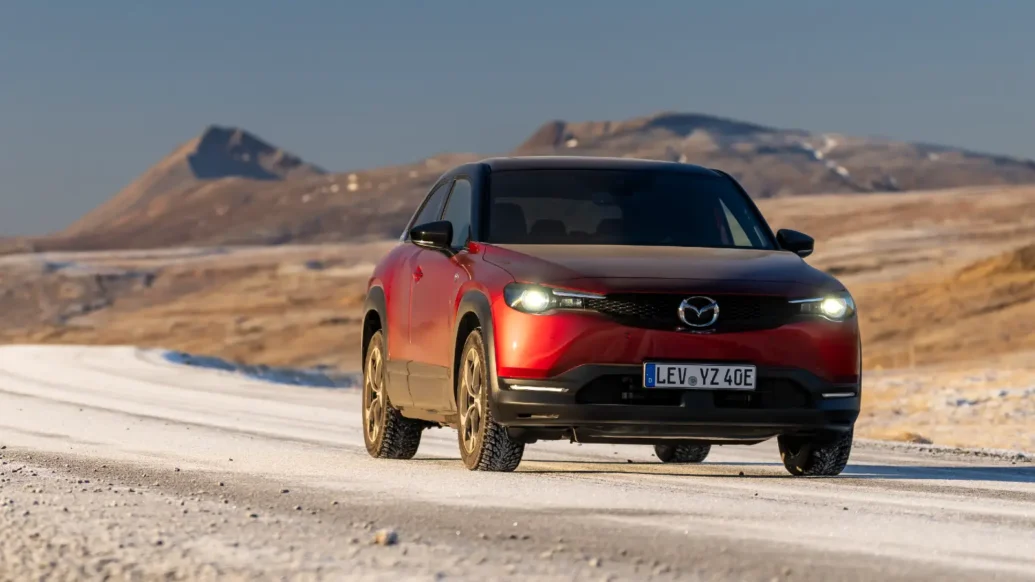
I’m standing outside the Carbon Recycling International plant in Iceland, being told that if there is a volcanic eruption, we must make our way calmly to the car park. The ground has been rumbling for a few weeks, and there’s tension amongst the locals, which is unusual as a bit of shaking is daily life on the Reykjanes Peninsula, just 20 miles from Reykjavik. I check where the keys to my Mazda MX-30 are and make sure I know which way the exits are.
As getaway cars go, the MX-30 probably isn’t ideal. It’s an electric car, but backed up by an innovative rotary engine that acts as a generator, creating electricity to drive the vehicle. It’s complicated, but it means you can keep going long after a pure electric car would have run out of power, needing just a two-minute top-up at a petrol station to keep going.

As this goes live at Average Janes, it’s apparent that the palpable unease on the island was justified, as the Eldvörp–Svartsengi volcano opened a lava-spewing fissure and continues to flood the Reykjanes area with molten, burning rock. The town of Grindavik has been evacuated, with some of it destroyed by the earth’s destructive power. The car park my Mazda was parked in is now just 250 metres from the highest-risk area, where warnings include risk of gas pollution, earthquakes, falling molten rocks, lava flow and fissures erupting without warning.
Looking back, I was quite pleased that range anxiety wasn’t going to be an issue.
We head to the safety of the Reykjavik Edition Hotel , arguably the capital’s first luxury hotel. With 253 rooms, it’s large by Icelandic standards, and has made no attempt to delicately hide within the harbourside architecture of the city. A dark facade of Shou-Sugi-Ban timber, charred using Japanese techniques, around a blackened steel frame projects a bold, dramatic aesthetic but one that mirrors Iceland’s volcanic past and present.

We’d eaten out, missing Edition’s promise of a spectacular dinner at Tides, the hotel’s famed restaurant. Exploring some of Reykjavik’s spectacular food scene, we ended up at Grillmarkaðurinn. This exceptional grill restaurant works to buy most of its ingredients directly from local farms, cooking meats over open coals and fire, using the smoke to delicately flavour perfectly cooked food, while a wonderfully curated wine list paired so well with our order. It’s traditional Icelandic fare — and hospitality — with a modern twist.
The Mazda MX-30 R-EV Takes on Iceland
After a night in the Edition’s minimalist yet somehow still plush room, with floor-to-ceiling windows offering up spectacular views, it was up early, ready to tackle parts of Iceland I’d never seen before.
Behind the wheel of the Mazda MX-30 R-EV by 7am, it was still pitch black. We wouldn’t see the sun for another four hours. There’s not much to hold interest as you make your way out of Reykjavik, especially in the dark, but it doesn’t take long to escape the city and start picking out gloomy silhouettes looming over us. There’s not enough light to see if they’re hills at the roadside or mountains further away.

The city roads are busy with Teslas — and a fair smattering of Mazdas, which outsells Subaru despite its famous 4×4 drivetrain and reliability — but that soon gives way to diesel-powered 4x4s. It’s the first real sign that the Icelandic countryside might demand more than a compact hatchback can deliver.
We’ve got a fully charged battery in the Mazda. At 17.8kWh, it’s about a quarter of the size of the battery in a Kia Niro and gives us a theoretical range of 53 miles. The reality is a little different, as the car, by default, doesn’t use all of the battery. Once it’s dropped to 45%, it switches on the tiny petrol-powered rotary engine hidden under the bonnet and balances energy use depending on what’s being asked of the car. As we cruise through the lowlands, the Mazda MX-30 isn’t under much stress, and it’s tough to tell whether the engine is running.
There always seems to be about 15–20 miles of range spare, according to the digital display ahead, so we know the engine is running. We keep going, the studded tyres making a racket on the tarmac surface, but it’s somehow soothing, even reassuring. Given the conditions and the lumps of metal sticking out of the tyres, we won’t find out about the car’s dynamic limits — Iceland is a law-abiding island, and doing something as reckless as speeding on the remote roads, far from emergency medical care, is punished with eye-watering fines. At least that’s what one of our unlucky colleagues told us.

As the sun threatens to break over the horizon, we can see more of what’s ahead, and it’s barren. Desolate, even, and surprisingly flat. We wind our way between lakes, passing by the occasional farm or tiny village, but rarely see another vehicle.
After 140 miles, we couldn’t feel more isolated. Reykjavik, less than 75 miles away in a straight line, feels like another world, another time. We’re at the southern end of the Hrútafjörður fjord, a dramatic piece of water surrounded by nothing but a few farmsteads and one village, Borðeyri, with 16 inhabitants.
We know what’s coming, so take the opportunity to pause for a moment. There’s a service station in the middle of nowhere, which seems like a good place to fill up with petrol — and coffee. With a full tank, we were good for 400 miles, but it was the thought of using the car as a protective safe haven that really necessitated the top-up. As we stand, sipping our service-station coffee and taking in the frosty landscape around us, the sun finally shows itself. It might be -5°C, and the wind might be whipping around to make it feel substantially colder, but we can’t help but stand for a few moments, feeling the fleeting warmth of its rays.


We turn off the main road, and almost immediately, the tarmac runs out. Now we know why there are so many 4x4s on the island — it’s not because of the weather, as Iceland is surprisingly mild, but because the ever-changing nature of the land means that roads shift, crack, and sometimes disappear entirely, so many are left as little more than tracks covered in volcanic gravel.
Even that doesn’t last long, as the weather up in the northwest is more threatening than in the south. The temperature drops, the winds increase, and the heated steering wheel of the Mazda MX-30 is called into action. The car might be as airtight as possible, but the cabin heat soon radiates from the windows, even with the climate control working to keep up.


We climb, battling narrow ice-covered tracks that, thanks to the ever-thickening layer of snow, don’t have clear edges. It’s impressive that the Mazda MX-30 tackled it without an issue, even when we took advantage of the visibility — you can see for miles — to make rather swifter progress than might be recommended. You’re shaken around, of course, but the suspension took a lifetime of abuse without an issue, with gravel, ice and rocks smashing their way along the underside of the car. While it’s a testament to the build quality, let’s hope the car gets comprehensively serviced before it goes to its next owner.
We have to cross the Westfjords, turning to the southwest and facing the peaks ahead of us. They’re not that high, at around 350m, but they’re exposed to the bitter winds from the North Atlantic Ocean. The land is nothing but basalt rock, stratified to create incredible scenery. But there’s nothing here, nothing at all, which explains why it’s the least populated area of the country.

So low is the population, and so exposed is the road we’re taking, that digital boards detail the temperatures, wind speed and, crucially, how many vehicles have passed by in the last day. If things go wrong, it gives you an idea of how long you’ll need to survive before somebody might stop to rescue you. It’s not inherently dangerous to drive, but it’s a lethal environment that takes no prisoners. It’s not a time to be foolhardy.
Weaving between columns of rock, we reach the summit and stop for a photo, momentarily looking brave in the face of 60mph sub-zero winds. The car, and the background, look spectacular, but we give up quickly and dive back into the warm cocoon of the Mazda.

Being sensible paid dividends. Dropping back to sea level, the road turned sharply to the left, with the mountain shadowing the surface. The invisible ice was expected, as we’d been looking well ahead, picking out hazards as far ahead as possible, but we can’t help but wonder how many have been caught out and found themselves heading 100 metres down into the frozen waters below. It was a sobering moment.
From there, it was back to relatively sensible roads, gradually getting busier and less demanding the closer we got to Reykjavik. We stopped at the Hraunsnef restaurant, nestled on a lava plain created around 4,000 years ago. It’s an otherworldly backdrop to a glorious lamb burger and chips — I never claimed to be sophisticated — that readied us for the final leg home.


Sweeping bridges, tunnels and ever-busier roads brought us gently back to civilisation. We’d only covered 350 miles, starting in darkness and ending as the sun sets. We’d long since stopped looking at how much energy the car’s battery had or what economy we were getting from the petrol engine. We’d forgotten it was anything special, which, in a roundabout way, is a compliment to the engineers and designers of the Mazda MX-30.
Could any other car have completed the journey we completed? Yes, and mostly without any difficulty, but facing the unforgiving Iceland terrain in an electric vehicle isn’t something I’d have relished. Yes, there are a lot of Teslas sold in the country, but they tend to sit on the driveway alongside something more rugged and less sustainable. The MX-30 R-EV is a halfway house, a stepping stone to full electrification while the infrastructure catches up with demand, and one that we’ve proven works in the most challenging of conditions. If it copes with this, it’ll cope with your commute to the office.


Shattered, we head to the Edition’s rooftop bar, unimaginatively called The Roof. Located on the seventh floor, it’s enclosed in wrap-around, floor-to-ceiling glass, with views over the mountains, ocean and old part of the city. The walls open onto a terrace that would be wonderful in the summer, but now, in the midst of winter, time spent outside was limited.

An Old Fashioned cocktail , made with Icelandic Floki Sherry Cask Finish whisky, seemed like a fitting way to end the day. Like the Mazda MX-30 R-EV, it’s a modern take on an established concept, blending the traditional with distinctive, artisan techniques to create something unique, memorable and utterly convincing.

- Volvo ES90 Plus review: Silence is golden - 7 May 2026
- Geely EX5 first drive: Spacious, sensible, forgettable - 10 April 2026
- NEWS This tiny Geely EX2 EV tops China’s sales charts — and it’s heading to the UK - 30 March 2026